
Key takeaways
- If fast food happens at lunch again and again, treat it as a workday routine with predictable cues, not as a fresh decision you somehow keep getting wrong.
- Make the lunch decision before you are hungry. A default lunch chosen at 10 AM is easier to follow than a nutrition debate at 12:30 PM.
- Keep a low-effort backup at work or nearby so the choice is not “meal prep or drive-thru.” Convenience has to exist on both sides.
- If the same restaurant or route pulls you in, change the route or add a location-based warning before you reach the point where the turn feels automatic.
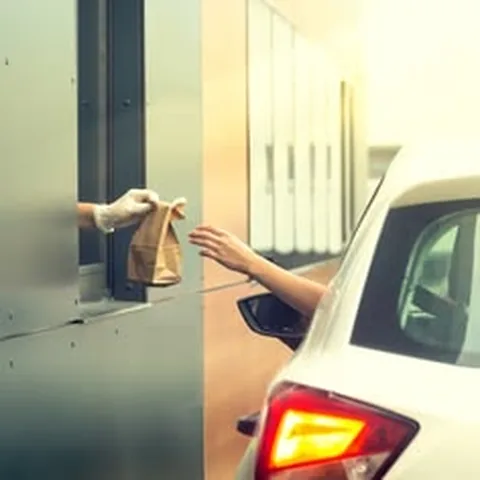
If lunch keeps turning into McDonald’s, Chick-fil-A, Wendy’s or another drive-thru even when you planned to eat differently, the useful clue is that it probably happens in a very similar way each day.
Same time. Same route. Same break. Same “I have nothing ready” feeling.
That makes lunch fast food one of the easier patterns to redesign, because you can prepare for the cue before it arrives.
The goal: decide lunch while your brain is calm, then make that decision easier to follow when noon arrives.
1. Identify the five minutes before you decide
Do not start with the restaurant. Start with what happens immediately before it.
Maybe you leave the office at 12:05. Maybe coworkers ask where everyone is going. Maybe you get in the car and the drive-thru is directly on your normal route. Maybe you realize at noon that you brought nothing.
Write down the trigger in one sentence: “At 12:15, when I get in my car hungry, I automatically think about the drive-thru.” That gives you a moment to target.
2. Decide your lunch before 11 AM
Waiting until you are hungry means fast food is competing on its best terms: speed, familiarity and convenience.
Instead, make a tiny decision earlier. Before 11 AM, answer one question: What am I eating for lunch today?
You do not need a weekly meal-prep spreadsheet. The answer can be leftovers, a sandwich, a grocery-store meal, something from a nearby cafe, or one planned fast food meal if that is what you choose. The point is that lunch is no longer invented in front of the drive-thru sign.
3. Build a three-level lunch backup
The easiest system has options for different energy levels:
If you need ideas that take almost no effort, use the same principle as these low-effort alternatives to fast food.
4. Change the route that triggers the turn
If you pass the same restaurant every day, the route itself can become part of the habit. You may find yourself thinking about the order before you have consciously decided what to eat.
For a few weeks, take a different exit, walk in the opposite direction, park somewhere else, or stay out of the car until you know where you are going. A slightly less convenient route can be easier than arguing with yourself while the drive-thru entrance is ten seconds away.
5. Use a “not yet” rule instead of a forever rule
At lunchtime, “never again” is usually less useful than a short delay.
Try: “If I want fast food at lunch, I wait 10 minutes and eat or drink something from my backup first.” You can still choose fast food afterward. The delay simply stops the first urge from making the entire decision.
6. Make your usual order less available
If you order ahead on the restaurant app, remove the shortcut. Log out. Turn off lunch notifications. Remove the app from your first home screen. If coworkers order as a group, decide before they ask whether you are joining.
Small barriers matter most when the habit is fast. If the whole decision normally takes 30 seconds, even a two-minute interruption can give your earlier plan a chance to win.
7. Use location as an early warning
Some lunch habits are tied more to place than hunger. If the same restaurant near work keeps pulling you in, the useful moment is before you are in the parking lot.
NOPE’s Radar is built for this kind of pattern: you choose the fast food locations that are a problem for you, and the app can warn you when you are getting close. The warning is not supposed to make the decision for you; it is there to interrupt the automatic route early enough to choose differently.
8. Track the pattern, not just the streak
If you eat fast food for lunch four times this week, record which days and what happened before each one. The useful information is not “I failed four times.” It is “three of the four happened after I left the office with no lunch plan.”
That tells you what to fix next week.
You can also use the fast food cost calculator if money is one of the reasons you want to cut back. Repeated work lunches can look small one at a time and very different when you see the monthly total.
9. Plan fast food instead of letting it happen
If you do not want to quit completely, choose the fast food lunch in advance. For example: Friday is the planned lunch out; Monday through Thursday use your default options.
A planned meal is different from an automatic one. It removes the daily negotiation while still leaving room for something you enjoy.
What a realistic first week looks like
If you currently buy fast food for lunch five days a week, do not make the first goal zero. Try replacing two lunches. Then three. Keep the easiest backup that worked and remove the one that did not.
The win is not becoming a perfect meal-prepper. It is reaching noon without feeling like the drive-thru is the only realistic option.
For the broader habit system, read our realistic plan for stopping fast food.
If the same problem happens after work instead, use our guide to stopping fast food on the way home.
FAQ
How do I stop getting fast food for lunch every day?
Decide lunch before you are hungry, keep one easy backup available, and change the route or cue that normally leads to the drive-thru. Start by replacing a few lunches rather than demanding a perfect week.
What should I eat for lunch instead of fast food?
Use options that are genuinely convenient for your workday: leftovers, sandwiches or wraps, microwave rice bowls, supermarket prepared meals, yogurt with fruit, soup, or another nearby option you choose before lunch starts.
What if my coworkers always get fast food?
Decide before the group asks whether you are joining. Bring or pre-order your alternative, suggest another place occasionally, or choose specific days when you join them so the social cue does not make the decision every day.