
Key takeaways
- A drive-thru habit is often tied to a route, time and cue, not just to hunger.
- Break the sequence early: change the route, decide food before driving and create a rule for the usual turn.
- Use location-based reminders before the restaurant so the pause happens while you still have a choice.
- Count the drives where you pass the old spot without stopping. Those repetitions are how the new routine becomes normal.
A drive-thru habit can feel strangely automatic. You may leave work intending to go home, then notice you are already in the lane ordering the same thing you ordered last week.
That does not mean you made no decision. It means the decision has been rehearsed so many times that the road itself may be doing part of the work: same hour, same intersection, same sign, same easy turn, same reward.
The best place to break that pattern is not at the speaker box. It is earlier.
Start here: map the drive-thru routine as a sequence — cue, turn, order, reward — and change the first step you realistically can.
1. Write down your exact drive-thru loop
Pick the restaurant you visit most and describe the trip in boring detail.
- Where are you coming from?
- What time is it usually?
- What road puts the restaurant in front of you?
- What are you feeling: hungry, tired, stressed, bored, rushed?
- What do you expect from the stop: food, a break, a reward, something easy?
That description tells you whether the strongest lever is route, timing, hunger, stress or convenience.
2. Change the route for long enough to stop rehearsing the turn
If you pass the same drive-thru every day, you are asking yourself to refuse the same cue every day. A different route lowers the number of decisions you need to make.
Use navigation even if you know the way home. Pick an alternative that avoids the restaurant completely for a few weeks. If there is no practical alternate route, choose the lane that makes the turn harder or decide in advance that you will pass the entrance before reconsidering.
If the whole commute is the trigger, our guide to stopping fast food on the way home gives you a fuller after-work plan.
3. Give the usual drive-thru time a new default
The old stop probably solves something. Maybe you are hungry. Maybe you need a transition after work. Maybe you want a reward before going home to more responsibilities.
Keep the function, change the routine. If hunger is the issue, have a planned snack or dinner ready. If the stop is a transition, use a podcast, a specific playlist, a short walk when you arrive home, or another small ritual that marks the end of work.
A replacement works better when it fits the same moment. A plan for Saturday morning will not help a Tuesday 6 PM drive-thru habit.
4. Decide your rule before you see the sign
Rules work best when they are concrete enough to follow without debate.
A vague goal such as “be better this week” gives the old routine too much room to negotiate.
5. Use a location cue against the location habit
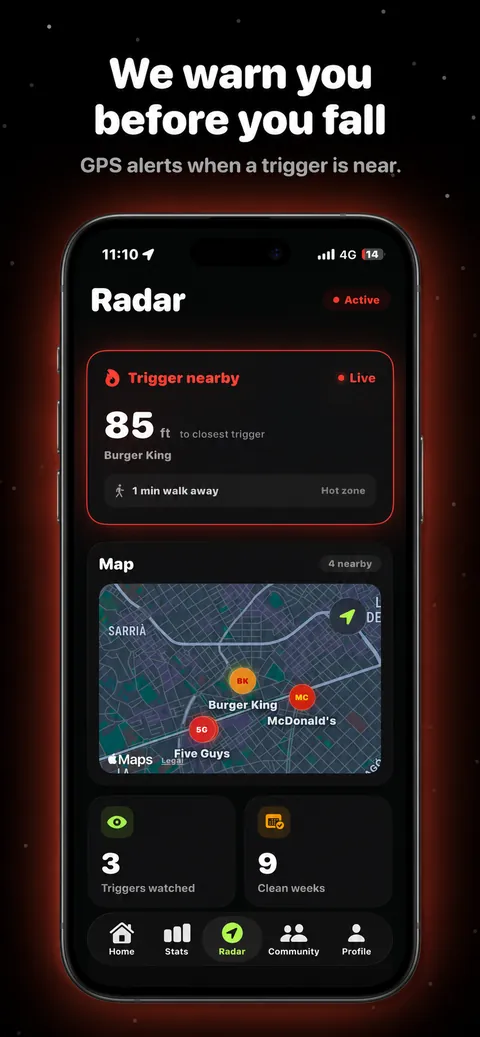
If the problem appears in the same place, a location-based reminder is more useful than a generic notification later in the day.
NOPE’s Radar is designed for this. You choose the fast-food chains or spots that matter to you, and the app can warn you when you get near them. That warning is a cue for the new routine: stay on the road, remember the plan, keep moving.
The aim is not to scare you away from a restaurant. It is to interrupt the “I was already turning in before I thought about it” moment.
Turn your usual fast-food spot into a warning point
The NOPE quiz helps identify the places and moments where you usually cave, then the app gives you tools — including Radar — to intervene before the old routine takes over.
6. Make the alternative genuinely convenient
If the drive-thru is your fastest reliable meal, you need an alternative that competes on effort, not just on intention.
Keep two or three “zero-energy” foods at home. Know which supermarket has prepared food on your route. If necessary, plan a non-fast-food stop that still gets you fed quickly while you are weakening the old routine.
You can use these quick alternatives for low-energy nights as a starting point.
7. Remove the tiny excuses that reopen the lane
Drive-thru habits often survive through exceptions: “I had a bad day,” “I am already nearby,” “There is nothing at home,” “I will start again tomorrow.”
You do not need to argue with every thought. Prepare the answer once. Bad day? Use the bad-day meal. Nothing at home? Go to the supermarket, not the drive-thru. Already nearby? Drive past and decide again after ten minutes.
Pre-decided answers reduce the amount of negotiating you have to do in the car.
8. Count clean passes, not just clean days
A useful metric is how many times you encountered the old cue and did something different.
If you passed the restaurant five times this week and stopped once, four repetitions of the new behavior happened. Notice them. The new route, new meal and new response are becoming more familiar.
If one stop happens, look for the part of the chain that changed. Did you take the old route? Skip lunch? Stay late? Turn off the reminder? Fix the earliest weak link rather than turning one stop into a lost week.
For a broader plan beyond the car, read how to stop eating fast food without relying on willpower.
FAQ
How long does it take to break a drive-thru habit?
There is no single timeline. The useful target is repeated drives where the old cue happens but the old stop does not. Make those repetitions easier with route changes, a planned meal and a rule for what you do when the urge appears.
Why do I keep going through the drive-thru even when I do not want to?
The stop may be attached to a repeated cue such as the commute, a specific intersection, hunger after work or the need for a quick reward. When the sequence is familiar, it can happen with very little deliberate thought.
What is the easiest way to stop going through the drive-thru?
Change the part of the routine that happens earliest: take a different route, decide food before driving, keep a backup option ready and use a reminder before you reach the usual restaurant.