
Key takeaways
- Stress can make fast food feel like relief because it is quick, familiar and requires almost no planning.
- The useful question is not “Why am I weak when stressed?” but “What does stress usually make me do next?”
- Create a short decompression step before ordering and keep an easy meal available so stress is not combined with hunger and decision fatigue.
- Track the trigger. Once “stress → fast food” becomes visible as a pattern, you can design a different first response.
If your fast-food cravings get louder when work is chaotic, you have an argument, money feels tight or you are simply overwhelmed, you are not imagining the pattern.
Fast food can become part of a stress routine because it solves several short-term problems at once: there is no cooking, no planning, the choice is familiar and the reward arrives quickly.
Over time, the feeling of stress itself can start pointing you toward the same response. That does not mean every craving is emotional, and it does not mean you need to analyze your childhood before dinner. It means the trigger is worth noticing.
Start here: when the craving hits, ask “Am I only hungry, or am I also trying to end this feeling as fast as possible?” The answer changes what you do next.
1. Stress makes “easy” more attractive
On a calm day, cooking something simple may feel reasonable. On a stressful day, even choosing what to cook can feel like another task.
That is why the same person can genuinely prefer eating at home in the morning and still be scrolling a delivery app by evening. The goal did not disappear. The cost of effort changed.
If this usually happens late, our guide to nighttime fast-food cravings covers the extra effect of tiredness and routine at the end of the day.
2. Notice what kind of stress sends you toward fast food
“Stress” is too broad to design around. Get more specific.
Look at your last few stressful orders or stops. The trigger you can name is the trigger you can plan for.
3. Separate decompression from dinner
A common trap is asking food to do two jobs: feed you and make the stressful feeling stop.
Try putting a short decompression step before the food decision. Make it five or ten minutes, not an elaborate wellness routine. Walk around the block. Shower. Sit in the car without opening a delivery app. Put on one song. Do a few slow breaths. Text the person you normally talk to after a bad day.
The point is not that these activities are “better” than food. The point is to give your nervous system another first move so ordering is no longer the only route out of the moment.
4. Do not let stress and extreme hunger arrive together
If you repeatedly reach the hardest part of your day having barely eaten, the decision becomes much harder. You do not need to micromanage meals, but it helps to notice whether stressful fast-food episodes also happen when you are very hungry.
If they do, plan something earlier: a normal lunch, an afternoon snack, or an easy meal you can eat immediately when you get home. The objective is to remove unnecessary urgency.
5. Put friction between the feeling and the order
When stress is the trigger, convenience can turn a feeling into a purchase in less than a minute. Add one barrier before the usual action.
- Turn off delivery-app notifications.
- Move or delete the app during your highest-risk days.
- Remove saved payment if that is practical.
- Choose a 10-minute delay before opening a menu.
- If the problem is a physical stop, take a route that skips the restaurant.
If delivery is your main stress response, use the more detailed fast-food delivery plan.
See the trigger before it turns into an order
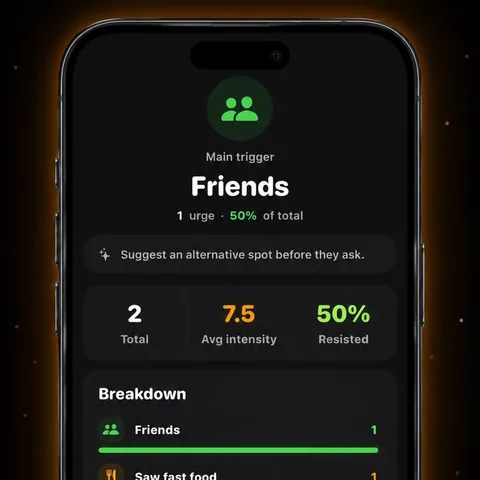
NOPE helps you log cravings and the situation around them, so repeated stress patterns become easier to see — and easier to interrupt the next time they show up.
6. Give stressful days their own dinner plan
A plan that works only on easy days is incomplete. Choose one “bad day” meal that requires almost nothing from you.
It might be a frozen meal you like, a supermarket rotisserie chicken with microwave rice, eggs on toast, a ready soup with bread, or something else that is fast and acceptable. This is not about nutritional perfection. It is about having an answer when your brain says, “I cannot deal with dinner.”
For more ideas, see our low-effort fast-food alternatives.
7. Track the urge without turning it into a verdict
When you log a craving, keep it simple: time, place, intensity and trigger. “Stress after meeting, 7/10, in car” is useful. “I have no discipline” is not.
After a week or two, patterns may become obvious. Maybe stressful workdays lead to delivery, while relationship stress leads to a drive-thru. Maybe the craving appears before you are actually hungry. Maybe the strongest factor is that no food is ready.
Use the pattern to change the environment. If the trigger is predictable, the response can be pre-decided.
8. If fast food still feels comforting, do not make that the enemy
You do not need to convince yourself that fast food tastes bad or provides zero comfort. The more useful goal is to stop it being the only reliable comfort routine you have.
Build alternatives that are realistic enough to use on the exact days you usually cave. Over time, “bad day = order fast food” can become “bad day = decompress first, eat the easy meal, then decide.” That is a much more workable change than demanding that stress never affect you.
For the broader craving picture, read why fast-food cravings happen in the first place.
FAQ
Why do I want fast food when I am stressed?
Stress can narrow your attention toward quick relief and familiar routines. If fast food has repeatedly been your end-of-day comfort, the feeling of stress itself can become a cue to order or stop for it.
How do I stop stress-eating fast food?
Start by separating the stress from the food decision. Name the trigger, delay the order for a short period, use one non-food decompression step, and keep an easy meal available so stress does not also become a dinner-planning problem.
What can I do instead of ordering fast food when stressed?
Choose a replacement that is fast enough to compete with the old habit: a short walk, shower, breathing exercise, music, texting someone, or eating a simple planned meal before deciding whether you still want fast food.